

5 Simple Tips for Eco-Conscious Travellers
Travelling with less CO₂ – how to travel in a more environmentally friendly way
1.1 Why getting there is often the biggest factor
1.2 Sustainable modes of transport
1.3 When flying is realistic – how to make it significantly better
1.4 Mini checklist – 3 minutes to a better journey
2.1 How to recognise CO₂-saving accommodation (without greenwashing)
2.2 Location & everyday life – why the right accommodation automatically makes your travel more environmentally friendly
Being green on the go – how to travel more sustainably
3.1 On foot, by bike or by public transport
3.2 Micro-rules – small decisions with a big impact
3.3 Slow travel – fewer changes, more experiences
Conscious consumption when travelling
4.1 Food & shopping
4.2 Souvenirs & activities
5.1 7 things + 5 routines that have an immediate effect
6.1 What does ‘sustainable travel’ actually mean, without me having to do everything perfectly?
6.2 Which 3 changes will have the greatest impact if I only have a little time?
6.3 How can I recognise sustainable accommodation and avoid greenwashing?
Want to go on holiday, discover new things and switch off – but also travel in an environmentally friendly way without feeling like you’re missing out or having to follow complicated rules? Then this topic is perfect for you. Sustainable travel doesn’t mean you have to optimise everything down to the smallest detail. It’s much more effective to make the few decisions with the greatest impact more consciously – and take a relaxed approach to the rest. That’s exactly why we’re giving you practical sustainable travel tips that work right away – whether you’re going on a city break, to the beach or into nature.
Travelling with Less CO₂ – How to Travel More Sustainably
The journey there is often the point where you can make a big difference with a single decision. This isn’t a moral lecture, but a practical shortcut: if you tackle the biggest lever first, a sustainable holiday suddenly feels feasible – instead of like an endless to-do list. And even if you can’t use every option in the end, you’ll be taking your trip step by step towards ‘greener travel’.
Why Transport to Your Destination Is Often the Biggest Lever
Many holidaymakers first concern themselves with minor details such as rubbish or towel changes – which is sensible, but often more a matter of fine-tuning. When it comes to getting there, however, it’s about setting a fundamental course: you make a decision once – and it affects the entire trip. Especially for short to medium distances, it’s therefore worth checking briefly whether there are alternatives that will get you to your destination without any hassle.
In short:
Sustainable travel doesn’t just start when you arrive at your destination, but on the way there.
Sustainable Modes of Transport
You don’t need to do any scientific calculations. It’s enough to realistically go through your options and then make the best choice that suits your route, schedule and budget.
For many routes, the train is one of the most relaxing options because you don’t have to ‘function’ while travelling. You can read, sleep or work, and you often arrive right in the centre. This has a pleasant side effect: when you arrive at the station, you often need less car on site and can travel more easily in an environmentally friendly way.
Long-distance buses are particularly interesting if you want to travel cheaply or find a direct connection that fits your schedule. For many routes, this is a pragmatic solution that gets you to your destination without much planning.
Carpooling is particularly worthwhile if you are travelling as a couple or as a group anyway. Sharing instead of driving alone is not only often cheaper, but also reduces ‘empty seats’ and makes the journey more efficient.
If you want to check this quickly, these guidelines will help you:
- Train, if you want to arrive comfortably and the connection is good.
- Long-distance bus, if your focus is on budget and direct connections.
Carpool, if flexibility is important or you are travelling with several people anyway.
Travelling with less CO₂ – how to travel in a more environmentally friendly way
1.1 Why getting there is often the biggest factor
1.2 Sustainable modes of transport
1.3 When flying is realistic – how to make it significantly better
1.4 Mini checklist – 3 minutes to a better journey
2.1 How to recognise CO₂-saving accommodation (without greenwashing)
2.2 Location & everyday life – why the right accommodation automatically makes your travel more environmentally friendly
Being green on the go – how to travel more sustainably
3.1 On foot, by bike or by public transport
3.2 Micro-rules – small decisions with a big impact
3.3 Slow travel – fewer changes, more experiences
Conscious consumption when travelling
4.1 Food & shopping
4.2 Souvenirs & activities
5.1 7 things + 5 routines that have an immediate effect
6.1 What does ‘sustainable travel’ actually mean, without me having to do everything perfectly?
6.2 Which 3 changes will have the greatest impact if I only have a little time?
6.3 How can I recognise sustainable accommodation and avoid greenwashing?
If Flying Is Realistic – How to Do It Better
Sometimes flying is simply the best option – e.g. for very long distances or when alternative connections would be extremely inconvenient. Even then, you can plan your trip much more consciously without ‘over-optimising’ your holiday. It’s not about perfection, but about making the best adjustments you can without stress.
If you fly, these points are particularly helpful:
- Direct flight instead of a transfer, if possible (fewer take-offs/landings).
- Pack lighter, because unnecessary luggage rarely makes you happier – but often makes the journey more difficult.
- It is better to stay longer than to take many short trips, because this is more efficient overall.
- Save on travel once you’re there by planning so that you can do a lot on foot or by public transport.
This is not a ‘free pass’, but it is the difference between “indifferent” and ‘conscious’. And that is precisely the idea behind a sustainable holiday.
Mini Checklist – A Better Journey in 3 Minutes
If you don’t have much time, this little routine will help you. It’s simple but effective – and that’s exactly why it works so well as an introduction to your sustainable travel tips:
- Is the route generally feasible without a car (train/long-distance bus)?
- Is there a direct connection if flying is necessary?
- Can I pack lighter without missing anything?
- Can I bundle the trip (stay longer instead of taking extra short trips)?
- Is my accommodation located in such a way that I don’t have to drive as much locally?
Find Low-Carbon Accommodation
Accommodation is more than just a bed for the night. It influences how you get around locally, how much energy and water you consume, and whether local structures benefit. For a sustainable holiday, it is therefore worth filtering not only for ‘beautiful’ and ‘cheap’, but also for criteria that help you travel in an environmentally friendly way – without the search getting out of hand. You don’t have to do everything perfectly: if you know a few clear signals, you will automatically make better decisions.
How to Recognise CO₂-Saving Accommodation (Without Greenwashing)
Many accommodations appear ‘green’ because they have the word ‘eco’ somewhere or a leaf icon appears. However, what is really helpful is whether you can find specific measures that are verifiable. Good tips are often surprisingly down-to-earth: save energy, use water wisely and reduce waste – and communicate this as transparently as possible.
Look out for these signals when reading:
- Energy: References to efficient heating/cooling systems, LED lighting, renewable energy or clear energy-saving measures.
- Water: Water-saving fittings, consciously controlled laundry/towel changes or clear information on water consumption.
- Waste & single-use items: Recycling/separation, fewer single-use products, refill dispensers instead of mini bottles.
- Transparency: Explanations of how something is implemented – not just ‘we are sustainable’.
A few simple questions are enough to quickly avoid greenwashing. You don’t have to ‘check’ anyone, just see if there is substance.
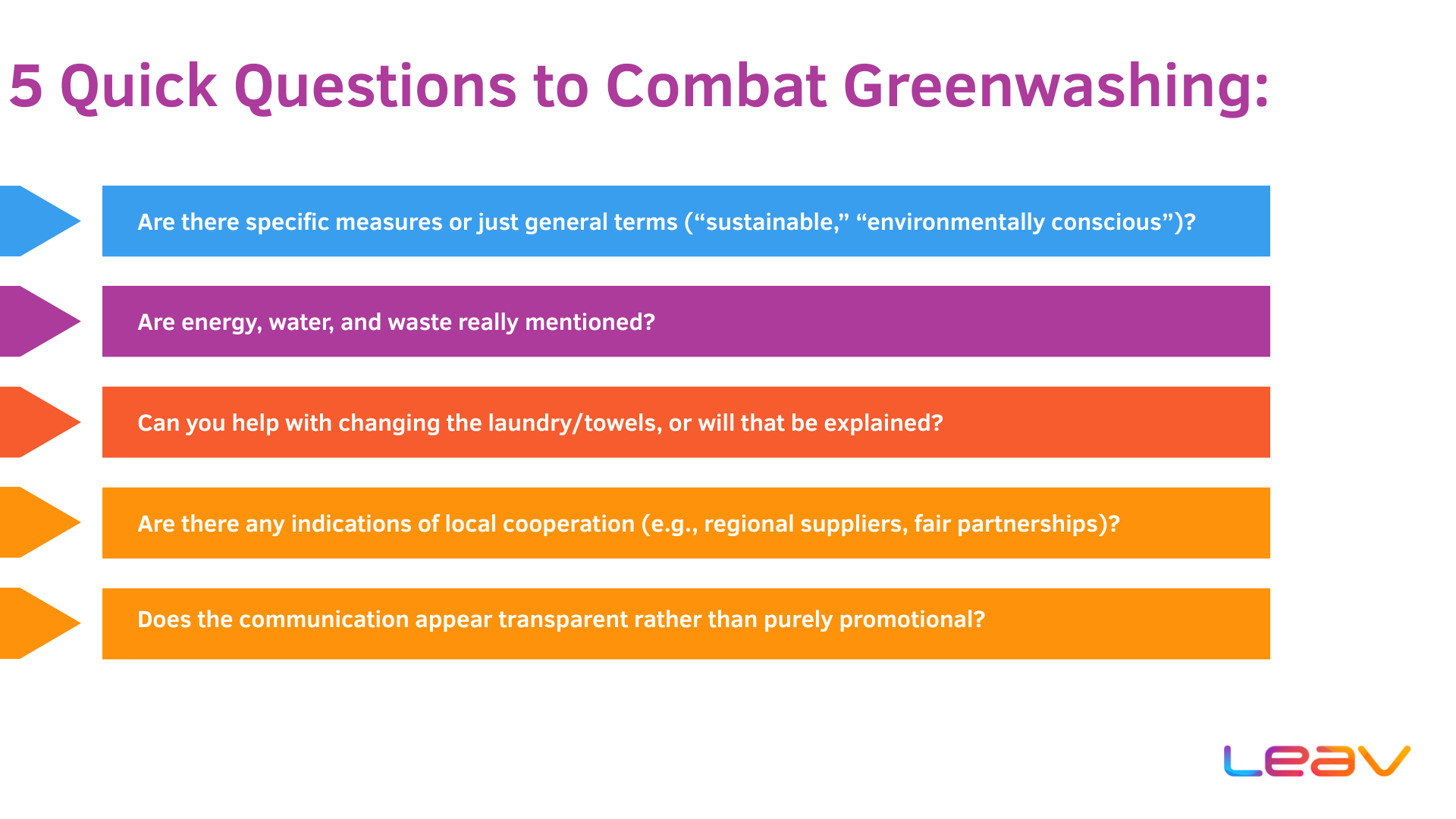
5 quick questions to combat greenwashing:
- Are there specific measures or just general terms (“sustainable”, ‘environmentally conscious’)?
- Are energy, water and waste really mentioned?
- Can you control the change of linen/towels or is this explained?
- Are there any references to local cooperation (e.g. regional suppliers, fair partnerships)?
Does the communication appear transparent rather than purely promotional?
Location & Everyday Life - Why the right Accommodation Automatically Makes Your Travel mMore Environmentally Friendly
One point that many people underestimate: even accommodation with great ‘green’ promises is less beneficial if you have to travel long distances every day to get there. That’s why location is often the most important factor. If you can get around easily on foot, by bike or by public transport, environmentally friendly travel on holiday becomes almost automatically easier – and doesn’t feel like a chore.
Practical location checks that help immediately:
- Is public transport (bus/train/tram) quickly accessible?
- Are supermarkets, restaurants and central locations within walking distance?
- Can you combine your trips instead of constantly driving back and forth?
Labels and seals can also provide guidance, but more as an additional signal. It becomes really powerful when certificates are mentioned together with concrete measures. If you keep this in mind, you’ll find accommodation that suits your sustainable holiday much more quickly – without spending hours researching.
Mini checklist for your search:
- Prioritise a good location (fewer journeys = less traffic)
- Look for concrete measures instead of buzzwords
- Value transparency more than icons
- If possible: stay longer instead of changing frequently (fewer transfers, less effort)
Getting Around Sustainably – How to Travel More Responsibly
How easy it feels to travel in an environmentally friendly way is often decided on the spot. This is because most emissions in everyday life are not caused by one big trip, but by many small journeys: a quick trip to the spot, a quick return, and then somewhere else in the evening. If you make conscious choices about your mobility here, your journey will automatically become greener – without you having to think about it all the time.
On Foot, by Bike or by Public Transport
Many distances on holiday are shorter than they seem at first glance. If you cover them on foot, by bike or by public transport, you will often not only be more relaxed, but you will also get to see much more of your destination. Walking is particularly suitable in city centres, along beach promenades or in old towns, where you will discover the most anyway if you stroll slowly through the streets. For medium distances, a bicycle or e-bike is a great solution because you remain flexible and still get close to your destination – ideal if you want to connect several spots without constantly changing modes of transport. And as soon as the distances get longer or the weather isn’t playing ball, public transport is often the most practical option: you can get from A to B quickly, without having to search for a parking space or make detours, and still remain in ‘environmentally friendly travel’ mode.
Micro Rules – Small Decisions with a Big Impact
To ensure that sustainable travel tips don’t just become a to-do list, it helps to set some simple rules and then stick to them.
- Combine journeys: plan visits to places in the same area together
- Use taxis consciously: as an exception rather than the norm
- Walk short distances: anything that takes 20–30 minutes is often worth it
Share smart: for gaps, not for every mini journey
Slow Travel – Fewer Changes, More Experiences
If you visit fewer places and stay longer, you save on transfers and many spontaneous trips. This often makes your holiday even more relaxing.
- Stay 1–2 nights longer in one place
- Fewer highlights per day, but no rush
Experience a region more intensively instead of just a quick visit everywhere
Conscious Consumption While Travelling
A sustainable holiday depends not only on how you travel and get around, but also on what you spend your money on while you’re away. When it comes to food, shopping and activities, even small decisions can make a big difference – without feeling like you’re missing out. When you consume more consciously, you often strengthen local structures, reduce unnecessary waste and usually even experience your destination more authentically. This is exactly how environmentally friendly travel becomes easy in everyday life.
Food & Shopping
When on holiday, it’s easy to fall back on what’s convenient: familiar chains, quick snacks, takeaways. But if you make a conscious effort to choose regional options instead, it’s often more sustainable – and often tastes better. Local suppliers usually work closer to the region, sometimes with shorter delivery routes and seasonal products. You also get a real feel for how local people live and eat.
A few simple decisions that help immediately:
- Eat more often in small, local restaurants instead of just large chains.
- Buy fruit, snacks or souvenirs at weekly markets or in small shops.
- If possible, choose regional and seasonal products.
- Use reusable items, e.g. water bottles or bags, to reduce single-use items.
This way, ‘conscious consumption while travelling’ becomes a natural habit – and not a to-do list.
If you’re looking for a destination that combines cuisine, culture and relaxed outdoor moments, check out ‘With Leav to Corfu – Late summer full of highlights’.
Souvenirs & Activities
Souvenirs are nice when they really are a memento – not when they disappear into a drawer after the holiday. That’s why there’s a simple rule when shopping: less is more, but make sure it’s high quality. Items that you can use in everyday life or that are locally made, such as handicrafts, spices, ceramics or textiles, are particularly useful. The more transparent the material and origin, the better.
Your activities are just as important. Some offers seem ‘harmless’, but have a greater impact on nature or local communities than you might think. If you choose more consciously, your holiday will not only be more sustainable, but often also more intense and authentic.
How to recognise good decisions:
- Crafts and local products instead of mass-produced goods
- One high-quality souvenir instead of many spontaneous purchases
- For tours: small groups instead of mass processing
- Providers who are transparent and respect nature and rules
- If possible: local guides and fair offers
This way, you support the right structures locally and automatically make your sustainable holiday more harmonious.
Conserve Resources
Even when taking a sustainable holiday, you don’t have to turn everything upside down. Often, a few simple routines are enough to automatically produce less waste, use water more consciously and save energy while travelling – without making your holiday feel any more ‘austere’. It is precisely these small habits that make environmentally friendly travel so effective in everyday life because they occur repeatedly: in hotel rooms, when packing, when eating out or when doing a quick shop.
7 Things + 5 Routines That Work Immediately
If you want to make it easy for yourself, set up a small basic setup and then stick to a few simple rules. It sounds trivial, but it’s exactly what works in practice.
7 things you use really often (instead of disposable items):
- Drinking bottle (saves lots of disposable bottles)
- Cloth bag or foldable shopping bag
- Small lunch box/reusable container for snacks
- Travel cutlery (or at least a spoon)
- Solid shampoo/soap or refill container
- Small towel/washcloth (handy when travelling)
- Mini thermos cup or reusable coffee-to-go cup
This will put you in a much better position without your luggage exploding.
5 routines that will noticeably reduce your consumption (without compromising on comfort):
- Do not have towels changed every day if it is not necessary.
- Take short showers and do not leave the water running when you do not need it.
- Use air conditioning/heating consciously (don’t keep it on maximum all the time).
- Turn off lights and appliances when you leave the room.
- Avoid waste instead of having to separate it: choose reusable items rather than disposable ones.
If you stick to these basics, you’ll be taking a very solid step towards sustainable travel tips – because you’ll automatically be travelling better every day without having to think about it all the time.

FAQ
What does ‘sustainable travel’ actually mean, without me having to do everything perfectly?
Above all, sustainable travel means making the decisions with the greatest impact more consciously – without overburdening yourself. If you plan your journey better, choose accommodation that allows you to do a lot on foot or by public transport, and make more local and sustainable consumption choices, you’re already well on your way. Perfection is not the goal. A sustainable holiday is the result of many small ‘better’ decisions, not 100% sacrifice.
Which three changes will have the greatest impact if I only have limited time?
If you want to keep it simple, focus on three things: Firstly, when travelling, always check briefly whether a train/long-distance coach or a more efficient option is realistic – this is often the biggest lever. Secondly, choose accommodation in a good location so that you have less travelling to do and environmentally friendly travel automatically becomes easier. Thirdly, reduce single-use items when travelling by carrying a water bottle and a small bag with you – this saves waste immediately, without any effort.
How can I recognise sustainable accommodation and avoid greenwashing?
Pay less attention to ‘eco’ buzzwords and more to concrete evidence. Good accommodation providers list verifiable measures relating to energy, water and waste (e.g. refillable dispensers instead of mini bottles, clear information on laundry changes, transparent sustainability measures). If, when reading, you get the feeling that only promises are being made but nothing is being explained, it is wise to be sceptical. Rule of thumb: the more concrete and transparent the information, the more likely it is to be a sustainable holiday.
For more behind-the-scenes insights, follow LEAV on Instagram and TikTok.