
Damascus Between Reunions: The Old City, the Umayyad Mosque & Souk al-Hamidiyya
Damascus Between Reunions – Arriving in a City of Echoes
When you think of Damascus, you think of a city that collects stories: of trade caravans and craftsmanship, of religions, encounters and reunions. Between reunions – between the moment you arrive and the moment you set off again – quiet moments unfold here, in which the past and the present intertwine.
This guide focuses on the sights of the Old Town: the winding alleyways themselves, the Umayyad Mosque as a spiritual centre, and the Souk al-Hamidiyya, where the cries of the traders sound like a familiar refrain. You’ll find your bearings, practical advice on visiting, and a sense of what Damascus feels like today – caught between longing, reunion and the tranquil pulse of a city dating back millennia.
The Old City of Damascus – A Labyrinth Steeped in History
The Old City of Damascus resembles a densely woven carpet: cobbled alleyways, shady courtyards, surprising glimmers of light. Here, Damascus’s major sights lie close together, and yet it is always worth straying from the main routes to peek into courtyard houses or find the tranquillity of a small chapel.
City Gates and the Straight Street
Bab Sharqi, the eastern gate, is an ideal starting point. From here, the legendary Straight Street (Via Recta) runs dead straight through the Old Town – a relic of Roman urban planning, now bustling with shops, workshops and cafés. The further you walk, the more the paths branch off, and with every turn you can delve deeper: into small courtyards, into neighbourhood life, into tile patterns that tell their own stories. To get an initial overview, it’s worth walking the entire length of Straight Street before venturing into the side streets.
Bab Touma and the Christian Quarter
The Christian Quarter around Bab Touma is a harmonious, quieter part of a walk through the Old Town. Churches, quiet squares and traditional guesthouses are clustered closely together here. It is the contrasts that captivate: the babble of voices on one corner, right next to it the metallic clang of a coppersmith’s workshop, and a few steps further on, the scent of spices. If you have time, make a point of setting aside moments without a fixed destination – in this quarter, it’s worth simply walking and stopping wherever you feel drawn to.
Courtyards, Khans and the Azem Palace
Behind unassuming doorways lie spacious courtyards, often featuring fountains, orange trees and black-and-white stone ornamentation. Many are now guesthouses, cafés or cultural venues. Khan As’ad Pasha, one of the city’s most impressive caravanserais, offers a glimpse into the trade and logistics of bygone eras. The Azem Palace (Qasr al-Azm), once the residence of the Ottoman governor, takes you through artfully decorated living quarters and courtyards bathed in soft shadows – a compact museum that helps you better understand everything else you see in the old town.
- Bab Sharqi – eastern city gate and starting point of Straight Street
- Bab Touma – Christian quarter with churches and guesthouses
- Azem Palace – museum in the former governor’s residence
- Khan As’ad Pasha – historic caravanserai with a vast inner courtyard
Fancy finding out more? Discover more city break ideas and city profiles on the LEAV Blog.
The Umayyad Mosque – The Heart and Symbol of the City
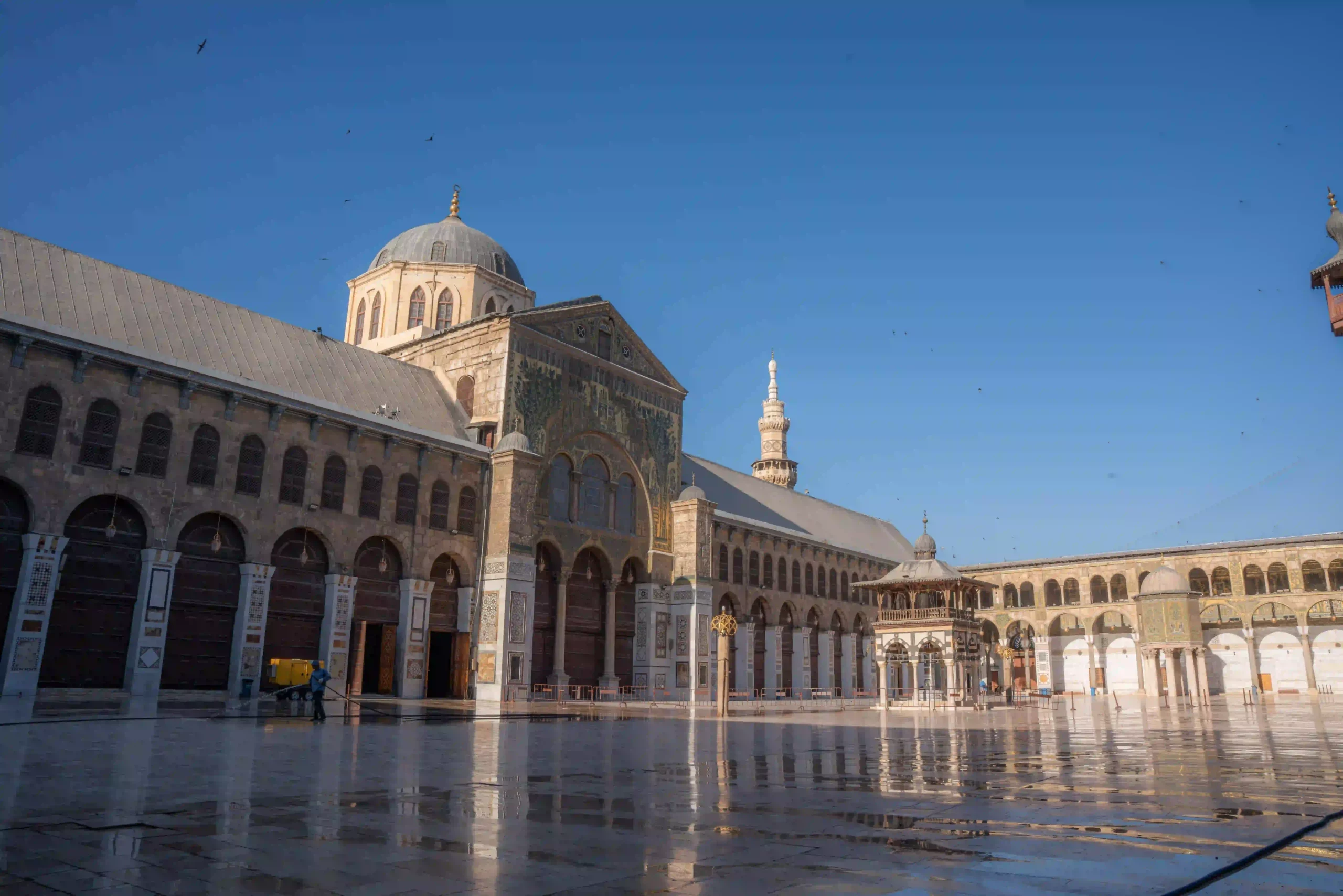
The Umayyad Mosque is the spiritual centre of the city and one of Damascus’s most iconic landmarks. As you step into the courtyard, you are greeted by the splendour of the mosaics, the expanse of the marble and the quiet footsteps of the visitors. It is a place where time seems to pass more slowly – world-famous, yet surprisingly quiet the moment you pause to reflect.
Architecture, Mosaics and History
The history of this site spans from a Roman temple to a Byzantine church and on to the grand mosque that has stood here since the 8th century. The vast courtyard, with its shimmering gold mosaics and minarets – including the so-called ‘Minaret of Jesus’ – creates a harmonious balance of proportion and light. Inside, you’ll find a spacious prayer hall with rows of columns, carpets and the shrine attributed to John the Baptist (Yahya). Here, architecture isn’t just something to be photographed, but also something to be heard: the crackle of footsteps on marble, quiet conversations, the swelling of the call to prayer.
Visiting Practices and Etiquette
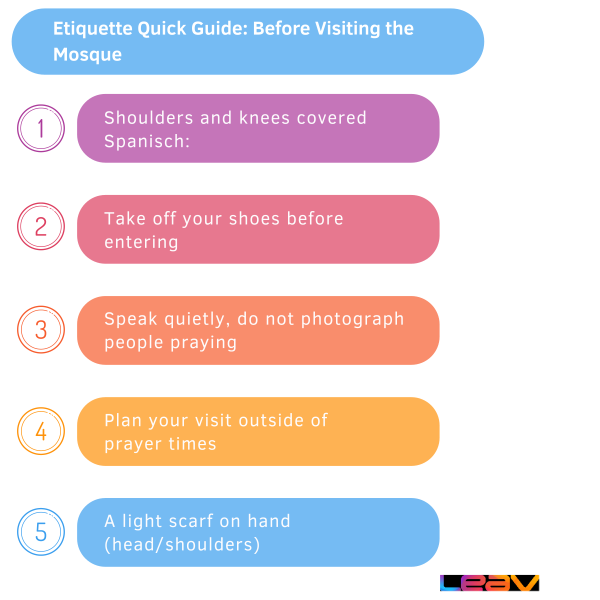
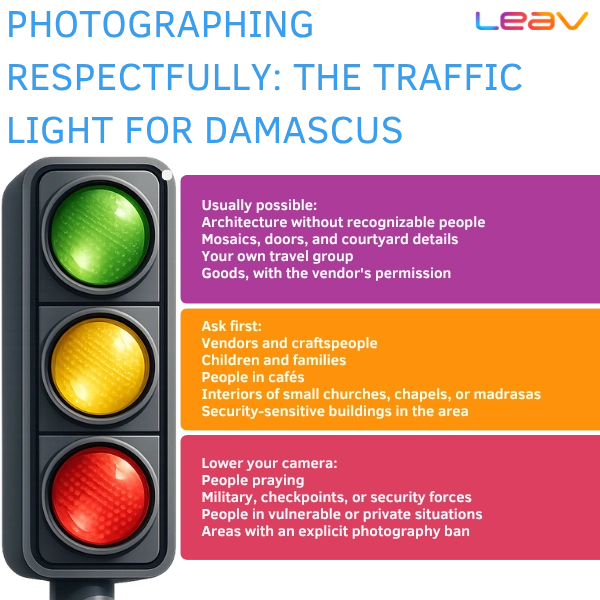
Plan your visit outside the main prayer times to experience the courtyard in peace. Appropriate clothing and respectful behaviour go without saying: shoulders and knees must be covered, and shoes must be removed before entering. Photography is usually permitted, but please be mindful of people at prayer. A tip for planning your visit: combine a visit to the mosque with a walk through the old town, so that both the grand moments and the small details come together over half a day.
- Clothing
Keep shoulders and knees covered; a light scarf is handy for covering your head or shoulders. - Best time to visit
Mornings outside prayer times are usually quieter than midday. - Behaviour
Speak quietly, do not take photographs of people at prayer, and remove your shoes at the entrance.
Before you set off: the LEAV travel checklist helps you keep track of everything before your flight.
Souk al-Hamidiyya – A Sight to Experience
The Souk al-Hamidiyya is the vibrant link between the city gates, traditional crafts and the Umayyad Mosque. Beneath its iconic, slightly perforated metal roof, dappled light falls on fabrics, leather, sweets and copperware. For many, the souk is one of Damascus’s most defining sights – not because of any single highlight, but because of the interplay of sounds, smells and encounters.
A Stroll Through Light, Colours and Craftsmanship
Don’t just look for ‘the one’ souvenir in the souk; keep your eyes and ears open for the craftsmanship and materials. Much of it is handcrafted, still produced in time with the rhythm of the city: embossed copper, cloths, embroidered pieces, wood and mother-of-pearl. If you have a little time, you can make eye contact, strike up brief conversations and watch the master craftspeople at work. Those who visit the souk in the early morning will find a more peaceful atmosphere; in the late afternoon, the hustle and bustle intensifies as families and groups of friends make their rounds.
- Copperware and metalwork
- Embroidered textiles and cloths
- Spices and perfume oils
- Traditional confectionery, such as nougat or pistachio biscuits
Shopping with Care: Quality, Prices, Respect
Strolling through the souk is all about striking a balance: between curiosity and respect, between comparing and deciding. Take your time, feel the materials, ask about their origin and how they’ve been made – many items have a story behind them that explains the price. Haggling is possible, but stay friendly; it’s less about ‘winning’ and more about both sides feeling satisfied. Ultimately, these principles are part of a sustainable and respectful way of travelling, which pays off not only in the souk.
- Compare before you buy
Similar goods can be found at several stalls; small differences in quality and craftsmanship are worth a second look. - Look out for craftsmanship
Embossed copper, inlay work or hand-woven cloths have distinctive features – ask how they were made. - Haggle politely
A smile and a little patience usually go further than high-pressure haggling.
More Sights Off the Beaten Track
Between the major attractions, it’s worth seeking out the city’s quieter spots. If you still have time and energy left after visiting a mosque, the souk and a stroll through the Old City, you’ll find a few more sights in Damascus that can easily be incorporated into your itinerary.
Saladin’s Mausoleum and Quiet Corners of the Old City
Right next to the Umayyad Mosque lies Saladin’s Mausoleum, a small but significant site with a peaceful atmosphere. In the immediate vicinity, madrasas and zawiyas line the streets, blending organically into the cityscape and rarely crowded. If the hustle and bustle of the main thoroughfares ever becomes too much for you, it is precisely these small, quieter corners that reveal Damascus in all its depth.
Views, Cafés and Little Rituals
A mocha at the historic Nofara Café near the mosque, an evening stroll through Bab Touma, a glance over towards Jebel Qasioun as the light begins to cool – it is these moments that linger in the memory as a quiet reunion. Even as the city changes, its rituals remain remarkably constant.
- Nofara Café – a time-honoured spot for mocha and storytellers
- Jebel Qasioun – viewpoint overlooking the city (check access in advance depending on the situation)
- Bab Touma in the evening – a quieter stroll with less hustle and bustle
Damascus is also a culinary attraction in its own right: start the day with fresh juices, followed by a plate of fatteh or kibbeh, and in the afternoon, a piece of ma’amoul or an ice cream at Bakdash, the traditional ice-cream parlour near the souk, whose chewy, mastic-flavoured speciality has been churned for generations.
- Breakfast on the go
Fresh juices and mocha from small stalls make for a relaxed start to the day. - A hearty break
Fatteh or kibbeh are ideal for a lunchtime break in one of the Old City’s alleyways. - A sweet finish
Ma’amoul, pistachio biscuits or the famous Bakdash ice cream round off your stroll.
Practical Tips and Planning for Your Visit to Damascus
Damascus is a city of short distances, but also of intense experiences. Plan carefully, drink plenty of water and allow some leeway for moments that might take longer than expected. That way, you’ll experience the Old City at a natural pace, rather than rushing from one highlight to the next.
Best Time to Visit and Climate
Spring and autumn are generally the most pleasant times for exploring the city. Temperatures are milder then, light and shade work in your favour in the narrow streets, and you can enjoy longer walks at a leisurely pace. In summer, it can get very hot; so plan shaded routes, take more breaks and visit indoor venues such as courtyards or museums. Religious festivals and Ramadan have a noticeable impact on the daily routine – this is not a hindrance, but rather an invitation to experience the rhythm of the city.
- Spring – mild climate, good conditions for long walks
- Autumn – similarly pleasant to spring, often with fewer tourists
- Summer – high temperatures; make sure to plan for indoor spaces and breaks
Culture, Clothing and Current Travel Advice
Dress modestly in religious sites and conservative neighbourhoods. A light scarf and long, loose-fitting clothing are both practical and respectful. Always ask permission before taking photographs of people. For your safety, please bear in mind that the situation in Syria can change at short notice. Before and during your trip, obtain information exclusively from official sources such as the Federal Foreign Office and respect local regulations, restricted areas and the advice provided by your accommodation – we cannot and do not wish to provide our own security assessment here.
- Choosing what to wear
Keep your shoulders and knees covered, particularly in religious and conservative neighbourhoods. - Get information before you travel
Check the latest travel and safety advice from official sources; do not rely solely on the romanticised image of travel. - Secure your documents
Carry important documents in digital form or as copies as well.
Think, Plan and Connect with LEAV Damascus
Damascus holds a special allure – especially ‘between reunions’. LEAV operates direct seasonal flights to Damascus. For your time there, you’ll find travel ideas, city experiences and cultural insights on the LEAV Blog. Entry requirements may change at short notice – only the advice from your Foreign Office and the relevant Syrian diplomatic mission is binding. The LEAV overview page provides a daily updated list of all bookable destinations, and you can find out more about the airline itself on the About LEAV page.
Travelling responsibly: Get LEAV’s tips for sustainable and respectful travel.
FAQ
How can I best combine the Old City, the Umayyad Mosque and the souk in a single day?
Start early at Bab Sharqi, stroll along Straight Street, turn off towards a courtyard house or the Azem Palace, and reach the Souk al-Hamidiyya by late morning. Treat yourself to a break there – perhaps an ice cream at Bakdash – and then visit the Umayyad Mosque outside of prayer times. In the afternoon, take a leisurely stroll past the Saladin Mausoleum towards Bab Touma for a coffee and a relaxing end to the day. The distances in the Old Town are short; with a few breaks, you’ll easily manage it all in a day.
Which sights in Damascus are worth visiting off the beaten track?
As well as the mosque, souk and the famous city gates, the Saladin Mausoleum, Khan As’ad Pasha, smaller madrasas and quiet courtyards away from Straight Street are well worth a visit. A coffee at the Nofara Café or a view of Jebel Qasioun will also give you a more complete picture of the city. Make a point of setting aside time without a fixed destination – that’s often where the most wonderful discoveries are made.
Are the mosque, the souk and the Old City among the most significant sights in Syria – or are there alternatives?
The Umayyad Mosque, the Souk al-Hamidiyya and the Old City are undoubtedly among Syria’s most iconic sights. In Damascus itself, places such as the Azem Palace, Khan As’ad Pasha and smaller madrasas round out your experience. Across the country, there are other well-known destinations – depending on the current situation and accessibility. Before making any plans, check the situation, travel routes and security conditions via official sources, and combine culture and encounters with responsible travel.
Note: Before making any bookings, check the latest travel and safety advice from official bodies, as well as the entry requirements of the relevant Syrian diplomatic mission abroad. The situation, entry requirements and transport links may change at short notice.