
Damascus Today: How the City Has Changed – And What to Expect When You See It Again

Understanding Damascus Today: Between Memory and the Present
For many people, Damascus is more than just a travel destination. The city may represent family history, childhood memories or a place with which you have a deep personal connection. Anyone thinking of visiting after a long absence therefore often carries two images with them: the Damascus of the past and the question of what the city feels like today.
For many people from the Syrian community, a trip to Damascus is not a typical city break. The focus is on reuniting with family and friends and revisiting familiar places. In the travel industry, such visits are often referred to as VFR trips – „Visiting Friends and Relatives“.
Damascus is often described through familiar impressions: narrow alleyways, courtyards with fountains, spices and soap in the souqs, the sound of hammering from small workshops or the chatter outside a coffee house. Many of these cultural aspects continue to shape the city. At the same time, conflict, economic hardship, emigration and political upheaval have transformed everyday life.
Anyone visiting again after many years is therefore unlikely to simply find „the old Damascus“ again. Some places feel familiar, whilst others bear visible signs of change. Shops may have closed or changed hands, routes may have changed, and everyday routines may require more patience. Encounters can also be emotional: for you, for relatives and for people who have lived there continuously.
The LEAV direct connection makes travelling from Germany easier. However, it does not alter the political and security situation on the ground. Such a trip cannot, therefore, be planned like a normal holiday. This article is neither an invitation to travel nor a guarantee of safety. It helps you to make sense of changes, to gently connect memories with the present, and to incorporate reliable information into your personal decision-making.
Memory As a Connection – Not As a Yardstick
Memories help you to recognise a city. However, they can also create expectations that the present is unlikely to fulfil. It is more helpful to carry your former Damascus with you as a personal connection, without comparing every place to how it was back then.
Perhaps a house is still standing, but the people from the past have moved away. Perhaps a workshop has disappeared, whilst a new meeting place has sprung up in the neighbourhood. Such changes do not automatically signify loss or progress. First and foremost, they tell us that a city and its inhabitants have had to respond to difficult years.
What May Feel Familiar
Some impressions are closely linked to the historical fabric and social rhythm of Damascus. These include the Old Town, religious sites, markets, traditional crafts and the importance of shared meals. Nevertheless, opening hours, access, the range of goods on offer and visitor numbers may vary.
These points of reference may help you when you arrive again:
- Sounds and smells
Workshops, bakeries, spices, coffee and voices often create a sense of familiarity more quickly than major tourist attractions. - Small routines
A cup of tea, a quiet courtyard or a short stroll through a familiar neighbourhood give you time to take in the present moment. - Personal connections
Family, friends and trusted local contacts can help you make sense of changes better than general travel guides. - Open-minded expectations
Don’t plan too many emotional reunions in a single day. A reunion should be allowed to unfold slowly.
Arriving with Sensitivity
A gentle start is particularly advisable for visits shaped by family or personal history. Give yourself time before visiting old addresses, former schools or places associated with difficult memories. Ask yourself not only what you want to see, but also how much you can take in in a single day.
Speak to local people respectfully and without assuming that they want to talk about experiences from recent years. Some share their stories openly, whilst others protect themselves through reserve. Both deserve respect.

The Cityscape, Neighbourhoods and Everyday Life in Flux
Damascus is not a uniform landscape. The historic Old Town, densely built-up residential neighbourhoods, wide thoroughfares and newer urban areas differ markedly from one another. Services, transport, opening hours and the security situation can be just as varied. An observation made in one neighbourhood cannot therefore automatically be applied to the whole city.
Old Town, Umayyad Mosque and Souqs
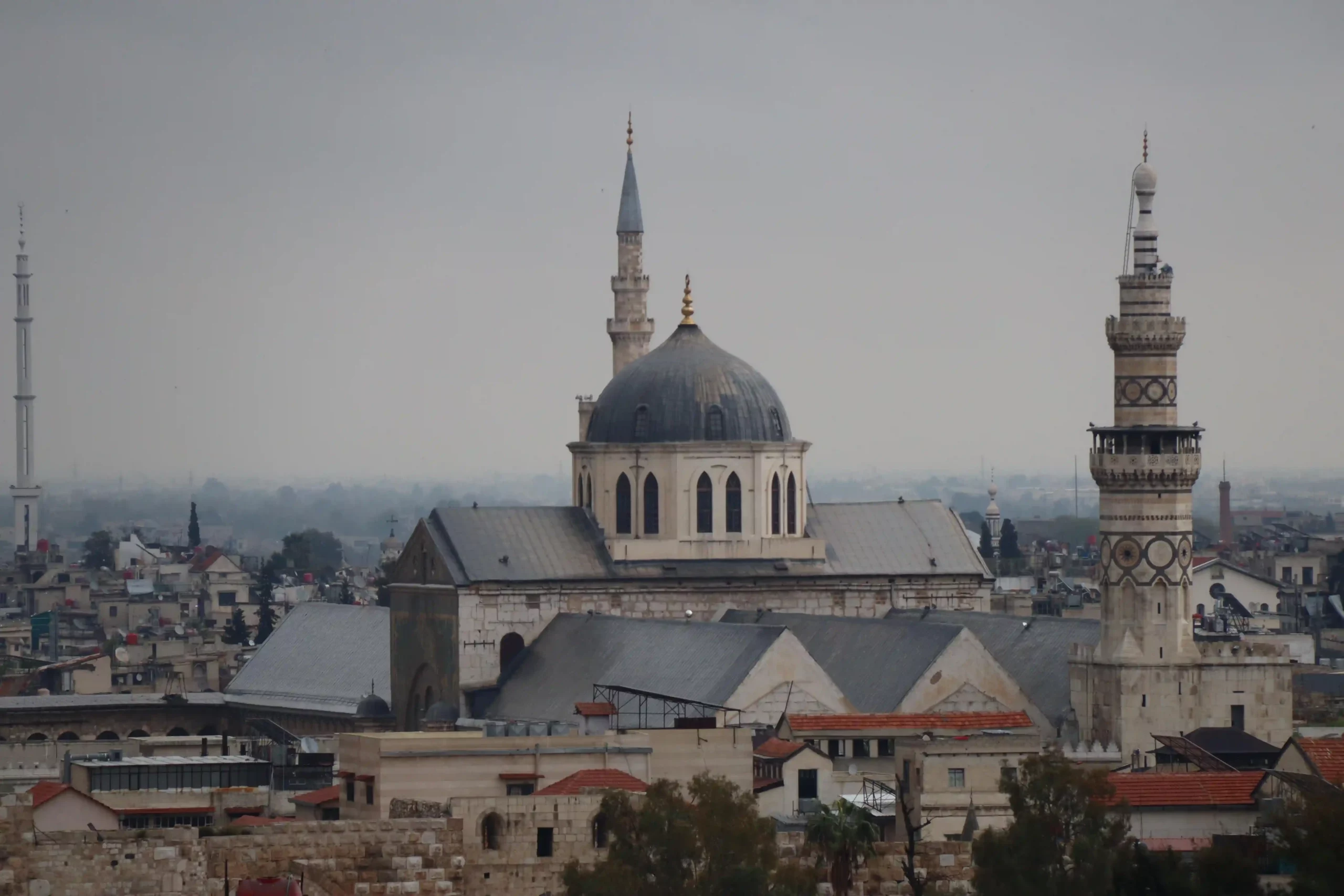
The Old Town remains a central cultural and emotional point of reference. Its narrow streets, residential buildings, religious sites and markets tell the story of centuries of urban history. The Umayyad Mosque is not merely a tourist attraction, but an active place of worship. You should consistently respect the dress code, prayer times, access rules and guidelines regarding photography.
From the Souk al-Hamidiyya, the paths lead on towards the Umayyad Mosque and through the alleyways of the historic Old Town. Spices, textiles, sweets and small workshops in many places evoke the Damascus of years gone by. However, the range of goods on offer, opening hours and visitor numbers may vary today.
The Via Recta, the „Straight Street“, also connects historic quarters and traditional Damascene houses. The surrounding area includes, amongst other things, the Christian quarter and various religious and cultural sites. Before visiting, check the current access arrangements and bear in mind that religious sites are, first and foremost, places of worship and community life.
The Old Town As a World Heritage Site – And What Its Status Means
The Old Town of Damascus has been on the UNESCO World Heritage List since 1979. The inclusion was justified, amongst other things, by the presence of around 125 architectural monuments from various eras – ranging from the ancient city layout and the Great Umayyad Mosque from the 8th century to Ottoman residential buildings and caravanserais. The title therefore does not refer to individual sights, but to the Old Town as a cohesive whole.
In 2013, the World Heritage Committee placed the Old Town, along with five other Syrian sites, on the List of World Heritage in Danger, where it remains to this day. This classification is not a judgement on the condition of individual buildings. It is a formal mechanism that requires regular reporting and opens up access to international support.
This has a practical benefit for you: the condition of the Old Town is continuously documented. If you want to know the state of a particular place, you will find more reliable information there than in individual travel accounts. At the same time, it is worth bearing in mind that the Old Town is not an open-air museum, but a lived-in neighbourhood where people work, shop and enjoy community life.
- Inscription on the World Heritage List: 1979
- Inclusion on the List of World Heritage in Danger: 2013
- Around 125 architectural monuments in a compact area
Beyond the Old Town: New Rhythms and Familiar Needs
Outside the historic walls, Damascus reveals itself as a large, dense and bustling capital. Cafés, shops and cultural initiatives can be places of exchange. However, their availability and accessibility may change. Therefore, do not rely solely on older recommendations, but check specific locations immediately before a planned visit via reliable local contacts.
It is helpful to adopt a perspective that neither romanticises nor looks exclusively for visible damage:
- Observe changes before you judge them.
There can be many reasons why a street is quiet – from the time of day and the economic situation to security measures. - Ask about current arrangements.
Opening hours, routes and meeting points may change at short notice. - Leave room for everyday life.
Not every encounter needs to become a major story. It is often the small conversations that paint a realistic picture. - Plan for breaks.
Traffic, checks, power cuts or emotional strain can mean a day turns out differently than expected.
Daily Life, Routes and Supplies
You can get around Damascus on foot, by taxi or via an organised transfer. Taxis and private transfers are the usual options for travelling from the airport to the city centre. However, it is not so much the theoretically available means of transport that matters as the current local situation. Checkpoints, road closures, heavy traffic and last-minute security measures can affect routes and journey times.
There is one particular aspect regarding payment that surprises many people: according to the Federal Foreign Office, credit cards still cannot be used in Syria – neither at cash machines nor in hotels. Payment is made in cash, and the Syrian pound cannot be exchanged outside the country (as at July 2026).
Where possible, arrange journeys and pick-up points with a reliable contact and also make a note of important addresses in Arabic. Allow plenty of time for delays and, for longer journeys or important appointments, do not rely solely on maps and journey times available online.
Factors that may significantly affect your daily routine:
- Checkpoints and last-minute road closures
- Power cuts and unreliable internet connection
- Cash-based economy with no card payments
- Varying or irregular opening hours
- Heat during the summer months
- Emotionally intense days that take more energy than planned
Safety and Responsibility: What You Need to Know Before Making Any Plans
A responsible assessment must be made clear at this point: the Federal Foreign Office continues to advise against travel to Syria. The security situation is considered tense and difficult to predict. The Foreign Office expressly points out that, since May 2026, there have been repeated security incidents even in the centre of Damascus, in particular attacks involving explosive devices that have resulted in deaths and injuries (as at 22.07.2026). Added to this are possible restrictions on air traffic, as well as the fact that the German Embassy in Damascus is closed to the general public; consequently, assistance to German nationals in an emergency is extremely limited.
You should therefore check the latest travel and security advice from the Federal Foreign Office before booking, immediately before departure and during your stay. If you hold another or additional nationality, you should also take into account the advice provided by the relevant authorities for that nationality.
The availability of a direct flight does not constitute a security-related recommendation. Airlines provide information on flight schedules and conditions of carriage. By contrast, the assessment of the security situation and binding entry requirements are the responsibility of the relevant government authorities.
Reliable Sources Rather Than Snapshots
The situation can change more quickly than blog articles or personal accounts can be updated. This post, too, is a snapshot. You should therefore consult several sources, preferably official ones:
- The Federal Foreign Office or the relevant authority in your country
- Syrian diplomatic missions abroad for legally binding entry information
- LEAV flight search for current dates and availability
- Travel insurance for cover, exclusions and repatriation services
- Reliable personal contacts on the ground for local developments
The LEAV travel tips provide support on general preparation topics. However, only the advice from the relevant authorities is authoritative when assessing the security situation in Syria.
Important Note If You Hold a Protection Status in Germany
If you are living in Germany as a person entitled to asylum, with refugee status, subsidiary protection or a confirmed ban on deportation, you are legally obliged to notify your immigration authority of any journey to your country of origin before departure and to state the reason for the journey (Section 47b of the German Residence Act, AufenthG). The immigration authority forwards this notification to the Federal Office for Migration and Refugees, which can then assess whether your protection status remains valid (Section 73b of the German Asylum Act, AsylG). Anyone who fails to make this notification is committing an administrative offence, which may be punishable by a fine.
There is no official regulation that expressly permits short visits or exploratory trips to Syria without any consequences for your protection status (as at August 2026).
As an airline, we cannot and are not permitted to assess what this means for your personal situation. Please clarify this with your immigration authority, an independent migration advice centre or a lawyer specialising in migration law before booking. Different rules apply to German nationals and to people with a residence permit that is not based on a protection status.
Your Personal Situation Upon Entry Into Syria
In addition to the rules in Germany, the way you are treated upon entry into Syria itself is also a factor. Nationality, family background, previous stays, occupational activity and entries in your passport may influence your entry and the treatment you receive from the authorities there. This applies in particular to dual nationals and people with a Syrian family history.
No one other than the relevant authorities can give you a definitive answer as to how your specific case will be assessed – neither an airline nor a forum, a social network nor a general account of someone’s experience. You should therefore clarify your situation well in advance and directly with the Syrian diplomatic mission abroad and with the authorities in your country of residence.
Photography and Behaviour in Public
Photography in Damascus requires particular discretion. Military and security-related facilities must not be photographed. The scope of this prohibition may be interpreted much more broadly than you might be used to in other countries. Caution is therefore advised even when photographing seemingly everyday infrastructure.
- Consistently avoid sensitive subjects
No checkpoints, security forces, military installations, government buildings, bridges or airports. - Ask before taking portraits
Explicitly ask for permission and do not publish any identifiable people without their consent. - If in doubt, don’t take any photos at all
If you’re unsure, leave your camera and smartphone put away. A photo isn’t worth the risk. - Remain discreet when talking too
Don’t press anyone for political or personal statements, and respect it if a topic is off limits.
When You Should Postpone Your Trip
A personal longing to visit Damascus can be strong. However, it should not lead you to downplay warning signs. Postpone your plans if information is contradictory, if reliable entry and exit procedures are unclear, or if you would have to rely on improvised assurances.
Particular caution is advised in two situations:
- If unauthorised intermediaries pressure you into booking quickly or demand that you hand over personal documents.
- If no reliable local contact person is available.
What LEAV Is Responsible for – And What It Is Not
To avoid raising any expectations that we cannot fulfil: LEAV is an airline, not an advisory service for entry requirements. We provide information on flight schedules, fares, luggage and everything else to do with your flight. Anything beyond that falls outside our remit.
For flights outside the Schengen Area, you are responsible for checking the entry requirements yourself – including your passport (please note the minimum validity period), visa, proof of a confirmed onward or return flight ticket, and any other requirements. We cannot provide binding information on passport and visa matters. Please contact the relevant embassy for this.
You can find general information on flight procedures in the LEAV Travel Information and in the LEAV Travel FAQ. This does not replace country-specific entry and customs regulations.
Use the LEAV Travel Checklist to help you organise your trip.
Travelling to Damascus with LEAV: Direct Flights and Travel Planning
LEAV offers a direct flight from Düsseldorf to Damascus. This gives members of the Syrian community, in particular, the opportunity to travel to the Syrian capital to visit family and friends without having to change flights.
According to LEAV, this is the first direct connection between Germany and Syria in almost 15 years. The legal basis for the resumption of direct flights is an air transport agreement between Germany and Syria concluded in mid-July 2026.
A Route for Visiting Family and Friends
The route is primarily geared towards so-called VFR travel. Unlike a traditional short break, „Visiting Friends and Relatives“ trips do not focus on a tightly packed sightseeing itinerary, but rather on spending time together.
Since the end of July 2026, LEAV has been operating the route between Düsseldorf and Damascus, initially with two flights a week. The service is offered on a seasonal basis. As flight days, departure times and availability are subject to change, you should not rely on general information or older screenshots when planning your trip. Only the dates displayed in the current LEAV flight search are binding.
What makes a direct connection easier in everyday life:
- No need to change airports
There are no transfers, long waiting times or the need to move between terminals. - Less stress for fellow travellers
This is particularly helpful if you are travelling with children or elderly relatives. - Simpler luggage planning
Longer family visits often involve more luggage than a short trip.
You can find further background information on the launch of this route in the press release LEAV Aviation flies from Düsseldorf to Damascus.
Find out in advance about your free baggage allowance, excess baggage and flight preparations.
Treat Flight Booking and Travel Decisions As Separate Matters
The connection makes the journey more direct, but it does not relieve you of the need to weigh up the options yourself. Before booking, check whether your documents and entry requirements have been clarified with the relevant authorities, whether any protection status you hold in Germany might be affected, whether your insurance is valid despite the travel warning, and whether you have reliable local contacts.
Shortly before departure, check your flight times, entry requirements and safety advice again. Save your booking documents, important telephone numbers and addresses offline and also keep paper copies to hand. This way, you will be less reliant on a stable internet connection or a fully charged smartphone. If you have any questions about an existing booking, the LEAV Service Centre will be happy to help.
Check the latest departure times for your flight to Damascus.
FAQ
When and from where does LEAV fly to Damascus?
LEAV offers seasonal direct flights from Düsseldorf to Damascus and has been operating the route since the end of July 2026, initially with two flights a week. As flight days and availability are subject to change, you can find the connections valid for your travel dates directly in the LEAV flight search.
Does the direct connection mean that travelling to Damascus is safe?
No. The introduction of a flight connection does not constitute a safety-related recommendation. A travel warning from the Federal Foreign Office remains in place for Syria, and the German Embassy in Damascus is closed to the general public. You should therefore check the latest advice before booking and again before departure, and take into account your personal legal, family and insurance circumstances.
What should I bear in mind when meeting people and taking photographs?
Please ask for explicit permission before taking any portrait photographs and do not publish images of identifiable people without their consent. Do not photograph military or security-related facilities, and exercise extreme caution when photographing government buildings, bridges, airports and other infrastructure. When conversing, listen carefully, do not press anyone for political or personal statements, and respect it if a topic is not to be discussed.
Note: A travel warning from the Federal Foreign Office remains in place for Syria. Before making any bookings, check the latest advice from official sources as well as the entry requirements of the relevant Syrian diplomatic mission. The situation, entry requirements and transport links may change at short notice.